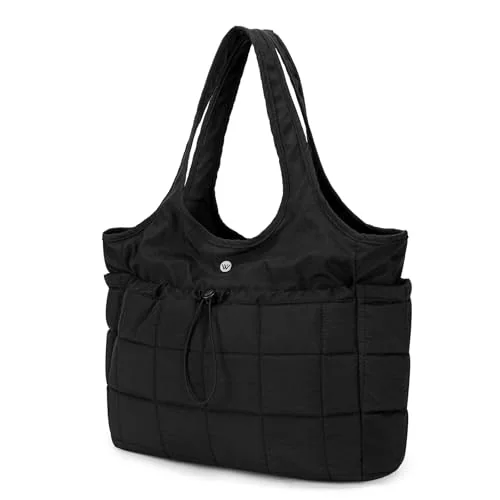
Hobo Bag
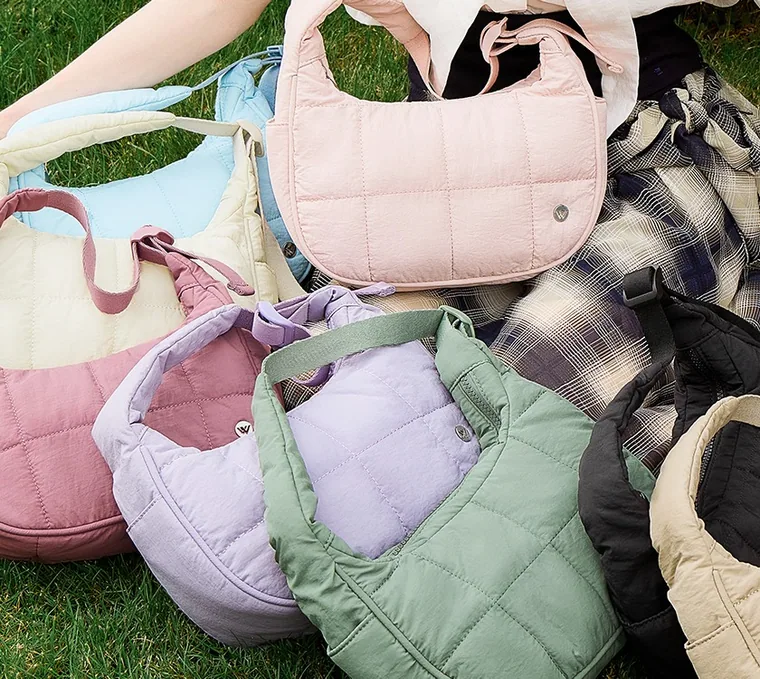
Puffer Hobo Bag, Black (14.6 in)
14.6 x 12.6 x 5.1 in · puffer
4.2 out of 5 · 89 ratings$19.99
A bag hurts for reasons that have almost nothing to do with how much it costs. Here is what actually decides whether your shoulder is fine at six in the evening.

This is general information about carrying a bag, not medical advice. If you have pain, numbness or tingling in an arm or hand, see a clinician rather than a bag guide.
Ask ten people why their bag hurts and nine will say it is too heavy. That is half an answer. Weight matters, but where the weight sits and how wide the strap is decide far more of what your shoulder feels by the end of a day.
We make light bags for a living, so we have a stake in this. That is exactly why this piece leans on published guidance rather than on our own opinion, and why every source below is named with the date we read it.
The short version: keep the load high and close, spread it across a wide strap, and switch sides before your body asks you to. Everything after this is detail.
A shoulder bag hangs from a joint that was not designed to carry anything. To stop the strap sliding off, you lift and hold that shoulder slightly higher than the other one. Hold it there for an hour and the muscles across the top of the shoulder and up the side of the neck never get to rest.
The load does not have to be dramatic for this to add up. A phone, a wallet, keys, a water bottle and a paperback come to about three pounds. Carried on one side for a commute, that is three pounds asking one set of muscles to stay switched on for forty minutes.
Clinical guidance is direct about this pattern. Cleveland Clinic lists it among the risk factors for thoracic outlet syndrome, a compression problem in the space between the neck and the chest.
Regularly carry heavy shoulder loads or lift things over your head.
The same page, in its advice on living with the condition, is blunter still.
Avoid carrying heavy bags on your shoulder or lifting objects above your head.
None of that means a shoulder bag is dangerous. It means a shoulder bag is a tool with a limit, and the limit arrives sooner than most people expect.
The clearest published advice on carrying comes from backpack guidance written for children, and it transfers to adults almost line for line. The American Academy of Orthopaedic Surgeons puts the strap first.
Always use both shoulder straps when carrying the backpack. The correct use of both of the wide, well-padded shoulder straps will help distribute the weight of the backpack across the back.
Two things in that sentence matter for any bag, not just a backpack. Wide. Padded. A narrow strap concentrates the same load into a thin line of pressure, and pressure is what you feel, not mass.
The second piece of that guidance is about packing, and it is the one almost nobody follows.
Organize the items inside so that heavier items are low and toward the center of the backpack.
Heavy things low and central. A water bottle standing upright against your back pulls far less than the same bottle rolling around at the outer edge of the bag.
The third line is the one we did not expect to find in an orthopaedic document, and it is worth quoting in full.
Consider using a crossbody bag as a good alternative for carrying books and supplies.
Three measurements decide how a bag behaves. All three are printed on almost nothing, so here is how to judge them by hand.
A strap under half an inch wide will dig, whatever it is made of. Between three quarters of an inch and an inch and a half is the comfortable band for a bag under three pounds. Wider than that and the strap starts to slip off a sloped shoulder unless it is textured.
A gathered or quilted strap behaves wider than it measures, because it spreads under load instead of folding into a cord. This is one of the few places where a soft bag beats a structured one outright.
Drop is the distance from the top of the strap to the top of the bag. Short drops of nine to eleven inches sit the bag under the arm, where your torso supports it. Long drops of twenty inches and more let the bag swing at the hip, and a swinging bag pulls at the shoulder twice with every step.
For a crossbody the useful measurement is the whole loop, not the drop. Somewhere between forty and forty-six inches puts the bag on the opposite hip for most adults. Shorter than that and it rides up under the ribs.
The closer the load sits to your spine, the less work it costs. A backpack tightened to the back beats the same backpack hanging loose by a wide margin. A crossbody worn snug beats the same bag on a loose strap. None of this is about the bag. It is about the gap between the bag and you.
Empty weight is the part you can control before you buy anything. It is also the part that is hardest to find published, so we measured it across our own range and printed it here.
| Silhouette | Pieces measured | Typical empty weight | As a share of a 3 lb load |
|---|---|---|---|
| Wristlet Wallet | 12 | 4 oz | 8% |
| Makeup Bag | 4 | 21 oz | 43% |
| Belt Bag | 11 | 6 oz | 13% |
| Crescent Bag | 27 | 8 oz | 16% |
| Crossbody Bag | 28 | 9 oz | 19% |
| Bucket Bag | 6 | 5 oz | 11% |
| Hobo Bag | 13 | 10 oz | 21% |
| Shoulder Bag | 2 | 9 oz | 19% |
| Tote Bag | 14 | 10 oz | 21% |
| Backpack | 9 | 9 oz | 19% |
| Travel Laptop Backpack | 2 | 16 oz | 32% |
| Duffle Bag | 9 | 15 oz | 31% |
Read that last column slowly. On a light quilted crossbody the bag itself is a small fraction of what you carry. On a structured leather bag of the same volume, the empty bag can be a third of the total before you put a single thing in it.
This is the whole argument for quilting, and it is a narrow one. Quilting buys you weight and nothing else. It does not buy you a bag that stands up on its own, and it does not buy you a bag that ages into something better.
There are days a shoulder bag cannot win. A full day of city walking with a laptop and a lunch is a backpack day. An airport with a long connection is a wheeled case day, whatever the bag looks like on the platform.
We would rather say that than sell you a tote for a job it will lose. Our totes take a laptop and a folder to a desk and back. They are not a good answer to eight hours on your feet with the same load.
The other honest limit is pain that does not go away. Numbness or tingling down an arm is not a bag problem to solve with a wider strap. That is a clinician's question, and the sooner it is asked the shorter the answer usually is.
People weigh the bag and forget the contents. Ask anyone to list what is in theirs and you get four things. Tip it out on a table and you get fourteen.
A rough tally from our own team, weighed on a kitchen scale: phone, six ounces. Keys with a fob, four. A slim wallet, five. Sunglasses in a hard case, four. A half litre bottle, eighteen. A paperback, nine. Cosmetics pouch, twelve. That is fifty-eight ounces, or about three and a half pounds, and not one of those items feels heavy on its own.
The bottle is the outlier and it is always the bottle. It weighs more than the phone, the keys and the wallet together. If you take one thing away from this piece, take the bottle out of the bag when you get where you are going.
The second offender is the thing you carry in case. A charger for a laptop that stays at home. An umbrella in July. A book you have not opened in a fortnight. None of it is heavy. All of it is there every single day.
Empty the bag onto a table on a Sunday. Put back only what you used in the last week. Weigh what is left over and carry that number in your head for a month. Most people find a pound they did not know they were carrying, and a pound on one shoulder for a year is not nothing.
First: put your own things in it. Not the shop's tissue paper. Your phone, your wallet, your bottle. A bag that swallows a display cushion can still be the wrong shape for a water bottle standing up.
Second: wear it for two minutes with the strap where you would actually wear it. Not on the forearm, the way everyone tries a bag on. On the shoulder, under the coat, walking to the far end of the room and back. Anything that is going to annoy you will start to annoy you inside those two minutes.
Buying online removes both tests, so the numbers have to do the work instead. That is why every piece we make carries its dimensions where the maker publishes them, and why the size ladder on our home page compares silhouettes side by side instead of one at a time.
Every strap joint in our range is bar-tacked, which means the stitching runs back and forth across itself at the point where the strap meets the body. That joint carries the whole load through a couple of centimetres of fabric, and it is the first thing to fail on a bag built to a price.
Straps are cut wide and quilted rather than narrow and stiff, for the reason in the width section above. The crossbody straps adjust across a range that lets the same bag sit high on the chest or low at the hip, because those are two different jobs and people do both.
None of that is a health claim and we are not making one. It is a description of what we sew and why, and you can check every part of it against the guidance we quoted.
Where this came from
American Academy of Orthopaedic Surgeons
Backpack Safety (OrthoInfo)
Cleveland Clinic
Thoracic Outlet Syndrome: Symptoms and Treatment
Every source above was opened and read on the date shown. Where a page says something we cannot verify ourselves, we quote it and name it rather than restating it as our own.
Shop what this piece is about
14.6 x 12.6 x 5.1 in · puffer
4.2 out of 5 · 89 ratings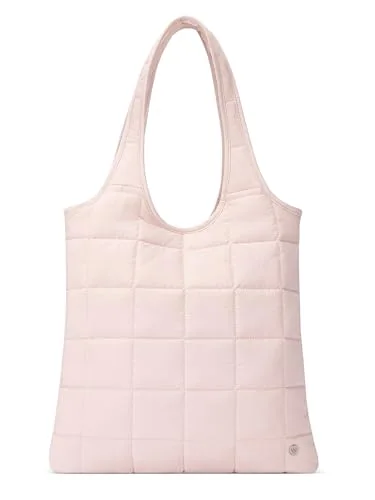
15.9 x 16.9 x 1.8 in · puffer
4.2 out of 5 · 89 ratings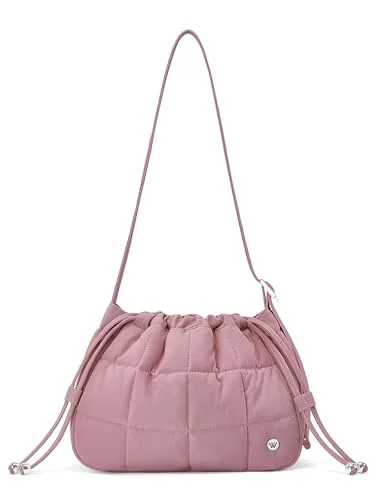
11.8 x 4.1 x 9.1 in · quilted
4.6 out of 5 · 42 ratings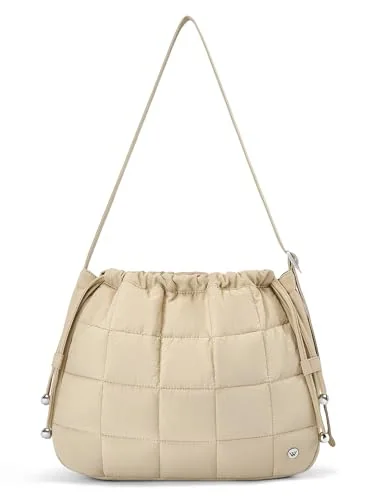
12.0 x 4.1 x 11.8 in · quilted
4.6 out of 5 · 42 ratingsKeep reading
What nylon is by legal definition, what quilting adds, why water resistant is not waterproof, and how to wash a bag without flattening it.
1,754 words
Why bag dimensions mislead, what everyday objects really take up, and a ladder of silhouettes measured across every piece we make.
1,691 words